Remembering a local environmental campaign –
Fifty years ago the inhabitants of many villages in the Aylesbury Vale became embroiled in a battle for the survival of their communities in the face of a proposal to build the third London airport near Wing in Buckinghamshire.
Had the airport been built it would have meant the destruction of nearby villages including Stewkley and Cublington; changing the character of the Vale and altering the lives of hundreds of people forever.
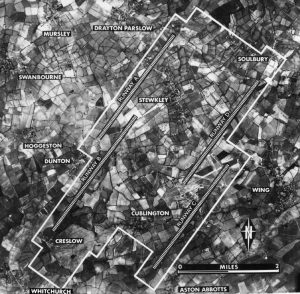
Map showing the proposed third London airport at Wing (Cublington)
Background
Following the opening of Heathrow in 1946 and Gatwick in 1958 the continued growth in commercial air traffic meant that by the early 1960s the question of a possible third London airport began to emerge, first through a House of Commons subcommittee and then an interdepartmental committee in 1961.
After considering issues such as air traffic control constraints and ground access the committee finally decided that Stansted, although not perfect, was the preferred site.
In December 1965 the government established a public inquiry into the development of Stansted. The inquiry ended in February 1966 and the report concluded that Stansted was only suitable as a location on the grounds of air traffic control; on others such as planning, access, noise, amenity and agriculture it fell down.
Resisting the idea of an independent commission, the government set in train another government review and the resultant White Paper concluded that Stansted was still the preferred option.
There was well organised local opposition to Stansted expansion and the publication of the White Paper created a public outcry. This, aligned with a change in ministerial responsibilities, a call for a new inquiry, and a highly critical debate in the House of Lords, finally led the government to reverse its earlier decisions and announce a new independent inquiry in February 1968 – the Roskill Commission.
The Roskill Commission
The Commission on The Third London Airport under the High Court Judge, Mr Justice Eustace Roskill was set up by the Board of Trade in May 1968.
An initial list of 78 sites was quickly reduced to an intermediate list of 29 by considering costs of surface access, defence and noise issues. This list was then further refined by considering the cost of additional factors such as air traffic control, site preparation and land take. The four sites shortlisted in 1969 for consideration were Wing (Cublington) in Buckinghamshire, Foulness in Essex, Nuthampstead in Hertfordshire and Thurleigh in Bedfordshire.
The Wing (Cublington) location was the site of a former Royal Air Force WW2 bomber training station (RAF Wing 1941-1956). The proposed development for a four-runway airport would have occupied more than three times the land area of Heathrow airport.
The Commission made its final decision after five public inquiries and the biggest cost/benefit analysis in history. The methodology chosen by the Roskill Commission was to work out the answer mathematically. They carried out a cost/benefit analysis on all the possible sites. They put a value on the noise of aircraft, the disruption of building work, the delay to flights, the extra traffic and calculated an answer. There were no value judgements; the figures would speak for themselves.
Just before Christmas, 1970, Wing (Cublington) became the firm recommendation to the Government on the basis of the cost/benefit analysis. The Roskill Commission report was published in January 1971.
However, some of the members of the Commission felt strongly that the recommendation was wrong. They believed that Foulness offered the best solution even though the Roskill cost/benefit methodology indicated that it would be significantly more expensive than siting the new airport at Wing (Cublington).
One Commission member, leading planner Colin Buchanan, produced a dissenting report rejecting the proposal to build at Wing (Cublington) as “an environmental disaster”.
“The Commission was excellent” said Professor Buchanan “it just got the small matter of the site wrong“.
Local Resistance
Two local farmers, Bill Manning and Peter Warren, organised a small local group to oppose development of Wing (Cublington). Desmond Fennel, a barrister living in Winslow, was involved with a group called the Silverstone Airport Resistance Association (SARA) opposing another of the sites initially considered by Roskill.
Prior to the publication of the 1969 Roskill shortlist, a newspaper leaked the names of the potential airport sites and therefore in March 1969, with the threat to Silverstone removed, the two groups combined their efforts to focus on opposition to the Wing (Cublington) proposal. SARA was renamed WARA (the Wing Airport Resistance Association) with Desmond Fennel as chairman and Bill Manning & Peter Warren as joint vice-chairmen. Activities were co-ordinated from an office in Leighton Buzzard.
The campaign was modelled on the previously highly successful opposition at Stansted and it did so with resources supplied by some very affluent residents. At its height, WARA claimed over sixty thousand signed-up members. To publicise the cause, thousands of pamphlets and car stickers were printed & distributed. Funds for the campaign were raised from numerous sources and at fund raising events such as Stewkley’s ‘mile of pennies’ outside the church.
Although the protests centred on Stewkley and Cublington, the campaign drew support from all the nearby communities and WARA unified and co-ordinated efforts from the whole area. Individuals from our own parish of Wingrave with Rowsham carried out much fund raising and were vocal in their criticism of the airport plans; the Parish Council made a strong submission to the relevant Public Inquiry.
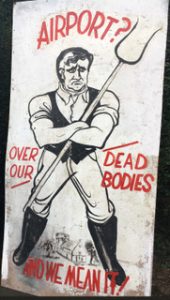
Protest poster
The local community efforts achieved global coverage in the press and on TV and enlisted the willing co-operation of many eminent people and national celebrities such as the poet John Betjeman and musicians Cleo Laine & Johnny Dankworth.
Despite this huge public campaign of protest, there was huge disappointment when the final recommendation was announced as Wing (Cublington) in December 1970.
Undeterred, WARA stepped up its campaign. Rallies were held, motorcades toured local villages and beacons were lit across the affected area. At one rally it was estimated that over ten thousand people attended.
 WARA meeting
|
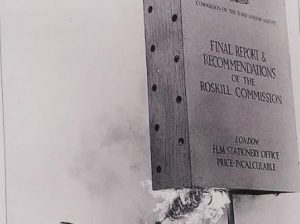 Ceremonial burning of an effigy of the Roskill Commission report
|
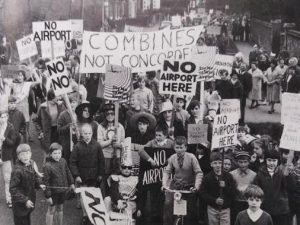 Protest march |
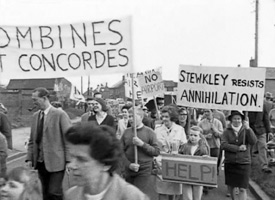 Demonstration |
The Outcome
The proposal to build London’s third airport at Wing (Cublington) came after the most detailed and costly planning exercise ever undertaken in Britain, but the mathematical cost-benefit analysis was shown to be flawed.
The Commission tried to weigh the price of everything; not just the building and infrastructure costs, but the indirect costs too. For example, when it came to Stewkely’s Norman church the Commission decided just to use the insurance value of £50,000.
Where the Commission had failed was in its inability to put a cost on community, family and village life.
Eventually, after the long and hard struggle, the WARA campaign succeeded. The government rejected the Roskill recommendation on environmental grounds, in favour of Maplin Sands, Foulness. The Conservative Government under Ted Heath agreed with the minority recommendation that the site at Foulness in the Thames Estuary, later renamed Maplin, should be developed rather than at Wing (Cublington).
The forces of economic reason may have declared for Wing (Cublington), but the forces of environmental emotion were in favour only of Foulness, and they proved far stronger both in number and in intensity. The weight of the planning profession, of the media, of general middle-class public opinion, and finally of MPs, shared the views of the dissenting Roskill Commission member, Professor Colin Buchanan; much to the annoyance of the Treasury.
Strong local opposition, mobilisation of public opinion and Prime Minister Ted Heath’s personal support for the Maplin Airport plans meant that the Wing (Cublington) plan was dropped. On April 26th, 1971, John Davis, the Secretary of State for Trade & Industry, told the House of Commons that the third London airport would now be built at Foulness Island, Essex.
The people of Aylesbury Vale had won their fight to stop the siting of a third London Airport near Wing in Buckinghamshire and were finally able to rejoice. Exuberant celebrations then followed and the BBC television programme, Panorama, opened with a film of the triumphal bonfire at Stewkley.
Professor Colin Buchanan, was knighted in 1972 and later became President of the Council for the Protection of Rural England.
In 1974, the incoming Labour Government under Harold Wilson cancelled the Maplin project because of the economic situation following the 1973 oil crisis.
Locally, WARA was hastily reconvened in May 1979 when the area around the hamlet of Hoggeston, near Dunton, was named as one of six sites identified for possible airport development. However also on the list was Stansted, the original proposal in the 1960’s, which had been resurrected as an option for long term development. In the event it was Stansted that was selected from the short list by the Conservative government in December 1979 and so the scare of a major airport development in the Aylesbury Vale was finally over.
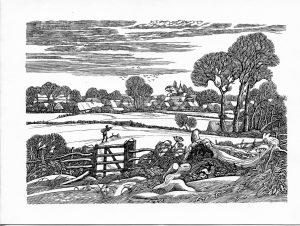 WARA Christmas Card showing the hamlet of Hoggeston (probably from the 1979 campaign). |
Click on the link above to see a pdf of the Christmas Card, showing the inscriptions inside. Engraving by Edward Stamp |
Local Legacy
In 1972, as a permanent celebration of the victory in the campaign against the proposed Wing (Cublington) airport, Buckinghamshire County Council planted a spinney of over 400 trees on a 3-acre site between Stewkley & Cublington.
Within the spinney is a monument, created in the shape of Concorde – the fastest & noisiest passenger aircraft of the time, that marks the centre of what would have been a four-runway airport.
On March 26th, 1972, the chairman of the Bucks Country Planning Committee officially unveiled the memorial plaque. The plaque reads:
|
CUBLINGTON SPINNEY This spinney was planted in 1972 by the Buckinghamshire County Council in gratitude to all those who supported the campaign against the recommendation that London’s third airport should be at Cublington. Parish councils, organisations, societies and many individuals contributed towards the costs of the spinney. This point is the centre of the area proposed for the airport. Midmost unmitigated England |
The concluding words ‘Midmost unmitigated England‘, from Henry James, were requested by the poet John Betjeman, who had been an ardent supporter of the aims & ideals of the Wing Airport Resistance Association throughout its campaign.
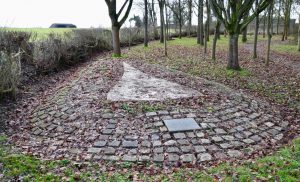 The monument in Cublington Spinney |
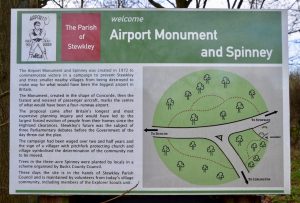 Information Board at the Airport Monument & Spinney |
Prepared by David Lloyd, January 2020
Sources: This article was compiled from various sources and contemporaneous documents. For a visual history of the local campaigns the following videos compiled by stewkleyfilms include film captured at the time:
https://www.youtube.com/watch?v=4zQNIrn8ETo
https://www.youtube.com/watch?v=7X3sVhZfeEY
https://www.youtube.com/watch?v=XDI0mshvuTU
