There is now no obvious evidence of any ‘mill’ in Mill Lane Wingrave and I initially feared that research would show that there never had been one, just as no trace has ever been found of a ‘castle’ in Castle Street (formerly Cat Street). However, I am glad to say my fears have proved to be entirely unfounded.
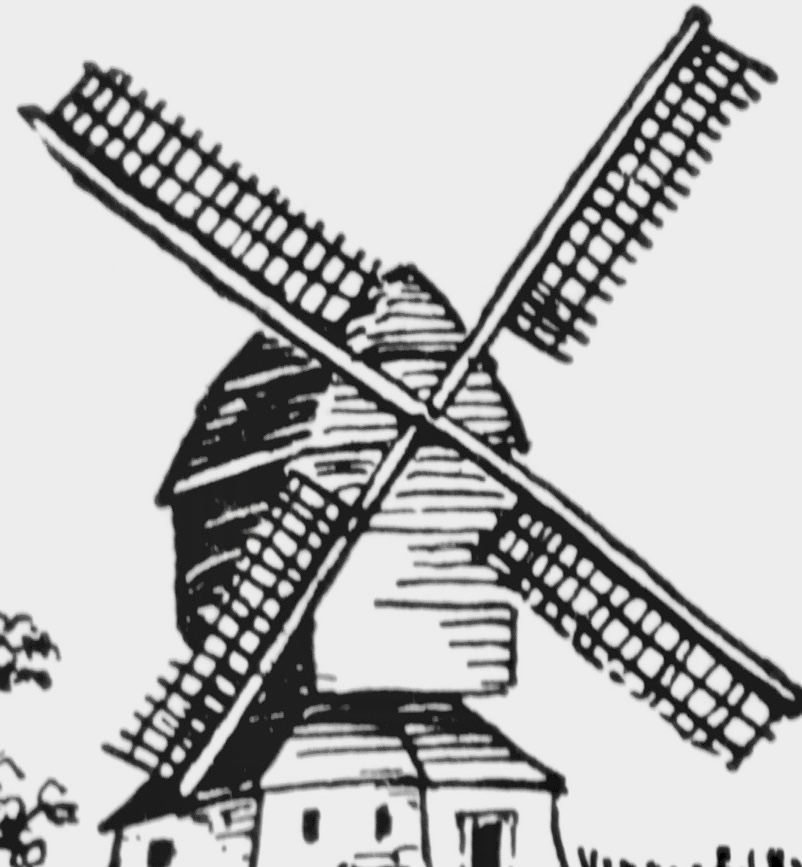
Definition of a windmill: Windmills are towers made of timber, brick or stone with sails to catch the wind and drive machinery inside to perform industrial operations such as grinding corn. The tower mill has a stationary stone or brick tower with a rotating cap so the sails can be turned into the wind. Smock mills are similar but have a timber body. Post mills are mounted on a post so that the whole body of the windmill can be turned into the wind.
Windmills appear to be a medieval innovation, but the earliest reference I could find to any windmill in Wingrave appears in the Churchwardens’ Accounts (1560 to 1760) for 1741 which refer to: ‘Pd. Sarah Brooks for beer on ye miller a/c 1/- and ‘Pd. Wm. Druce for beer on ye miller a/c 1/-‘. As Wingrave lies on the Thames/Ouse watershed, the mill could not have been water driven, and therefore a windmill on the south facing escarpment appeared most likely. But where exactly?
I remembered that Andrew Muir had written a history* of Windmill Hill Farm (formerly Windmill Farmhouse), his home in Mill Lane which he shares with his wife, Jane. In particular, Andrew sought to identify the owners and occupiers of his home during the 18th and 19th centuries and I am indebted to him for his research on the Griffin family.
In 1765 Robert Griffin had arrived in Wingrave with his wife and young family. He needed a house in which to live and work. Circumstantial evidence suggests that he chose Windmill Farmhouse, as this was extended later in the 18th century by the installation of a large bread oven and expanded chimney. These alterations suggest that baking on a wholesale basis was being undertaken in the house with a windmill nearby.
The 1798 Enclosure documents record that Robert’s son, John Griffin, was also the occupier of a dwelling and bakehouse in Mill Lane, namely where Rose Cottage (28 Mill Lane) now stands. Robert lived until 1821 and by his will gave to John “all my tenement, baker’s shop and premises in Wingrave wherein I now dwell and all my Close in Wingrave which I now occupy”. It may be concluded that both Robert and John were working and trading as bakers in Mill Lane in the late 1700s and early 1800s.
We know for certain that in 1809 John Griffin erected a large smock mill in the grounds of Rose Cottage. This had been built originally at a site at Dinns Mill, Whitchurch but it had been found to be in an unsuitable position attracting little or no wind.
An advertisement had appeared in the Reading Mercury on March 20th 1809:-
“To be sold by auction at the King’s Head Aylesbury, a smock mill entirely newly built about 4 years ago, works one pair of stones or is prepared for the introduction of another pair. Apply Mr Goodson, Whitchurch.”
John Griffin purchased and dismantled the mill and then transferred it by cart to Rose Cottage where he re-assembled it in an elevated position. At the time, the west end of Mill Lane was known as Mill End and the first field sloping down the hillside from the site of the mill is named on the Enclosure map as “Mill Close”.
Land Tax records of 1831/32 indicate that the smock mill and adjoining land remained in the occupation of John Griffin, but that the owner was John Gibbs at least from 1832.
Next, there is reference to improvement and repair of the mill in the edition of the ’Aylesbury News’ of 4th December 1841**:
“Wingrave Mill. The mill having undergone extensive improvements and repairs, Wm. Burton begs to inform his friends that he will work night and day (wind permitting) to fetch up his arrears of grinding. Goods fetched and carried any reasonable distance, strict attention paid to the wants of customers and moderate charges”.
***However, Mr Burton’s quest for business appears to have failed because in April 1852, Mr Gibbs was seeking a new tenant:
“Capital windmill, bakehouse, dwelling and grocer’s shop, well situated, for trade in Wingrave driving 3 pairs of stones. None but practical miller will be treated with”.
Mr Gibbs tried again in July 1852:- “To let at Wingrave a substantial smock mill, driving 3 pairs of stones, excellent condition, separate house for miller”.
A procession of tenants continued with Jabez Burton (1853-4), Tom Payne (dates unknown) and finally George Rickard, who became both owner and occupier of the mill until 1872 when he ceased using it and opened a new steam mill in Winslow Road.
George Rickard was the uncle of Joseph Rickard, the grandfather of none other than Prudence Goodwin. Joseph described the mill as follows;-
“It stood upon a stone base about 2 feet high with 4 or 5 steps up to the door. The body was of the usual tapered octagonal shape and was of medium height. The cap was dome shaped. I am certain that the whole body revolved upon the base over which it had an overhang, like some of the thatched-walled Dutch windmills. The tailpole projected almost horizontally from near the bottom of the mill with a cart wheel attached to the end of it. Two pairs of stones of about 4 feet were upon a hurst frame and all the machinery was made of wood. The mill had 4 sails, probably made of cloth, which turned very near to the ground as they once killed a pig.”
If this description of this smock mill is accurate, it is a surprising one. As described in italics above, a smock mill (eg at Lacey Green) normally differs from a post mill in that the body does not rotate, but like a tower mill (eg Pitstone Windmill) it is the cap that rotates to face the wind.
By 1880, it appears that two of the sails of the mill became partially detached and it soon lapsed into a dilapidated state and was pulled down. A nice footnote is that the eastern roof of Windmill Farmhouse was soon reinforced by two timbers, which from their size and shape appear to be the former windmill sails.
*Windmill Farmhouse, Wingrave. BAS Survey and Report by Andrew Muir- March 2012
**Buckinghamshire Heritage Portal. Monument record 0179500000 Garden of Rose Cottage
*** Unpublished note by Stanley Freese in 1939
This article was prepared in March 2022 by Richard Keighley for the Wingrave with Rowsham Heritage Association